So lets start figuring out these metal foundations for basements applications:
Steel:
This is actually a wood foundation clad with a thick layer of galvanized steel. There would be a poured concrete base. Then the actual foundaiton would be a wood stud structure, double-shelled, filled with insulation. Then towards the outside, there would be an air space of about 1.5 inches created with something like Unistrut, though I prefer something cheaper (unistrut is so expensive).
then the galv steel cladding. We're talking about 11 gauge (0.120 inches thick), welded or screwed (that would be annoying) to the unistrut from the outside. Stich welded between panels. Zinc oxide gases coming off everywhere fromo the welding, - gas masks for the welders -
I got a price on the galv steel sheet from North York Iron - $107.25/sheet (thats $.67/lb), 37 sheets (148ft perimeter on my building). This is for a total cost for the sheets of $3968. The sheets are heavy, 160lbs each, so not fun to handle - maybe some kind of small crane....But this way, one could make a very thin, and durable exterior shell for a building without suffering the 8 or 10 inches of concrete, probably for a competitive price. The total shell thickness including the airspace can be about 2" or less. On ecan get another 6" of insulation in the same space as for a concrete foundation. The steel can be sprayed and a dimpled poly membrane installed just like a concrete foundation - for better corrosion resistance, though I've found galvanzied steel (doesn't have to be hot-dipped) holds up well. No poisonous pressure-treated lumber involved, and carbon footprint could be similar or better than the poured concrete. Thermal expansion co-efficient of the steel is similar to concrete, so not an issue.
Now: Aluminum foundation: Same idea as the steel, but no corrosion issue, unless you have a very salty and wet soil....Using the same 1/8" thick sheets, the weight of each sheet will only be about 53lb. Lighter than a sheet of fiber-cement or drywall - much thinner, of course. I would not weld these in place, I would use aluminum brazing, although corrosion-resistance of the braze would need to be checked. This way, the foundation would be sealed entirely, and fastened well at the same time. I would skip the dimpled membrane and spray. Apparently the price of Aluminum is about $.65/lb - at this price we are looking about $35/sheet of 4'x8' - cheaper than 3/4" S1S fir plywood!
At first I thought thermal expansion would be an issue, but note that the ground temperatures are pretty stable - fluctuating only some 10 degrees C or so throughout the year. But thermal conductivity of Al being so high, one might start to wonder if the ground around the foundation would get quite cold, even at the bottom - Hello Therm simulation.
LT
Friday, January 28, 2011


Thursday, January 27, 2011
Fiber Cement in Below Grade Applications
I'm looking (without success) for a thin, impermeable sheet-like product for use in a below-grade exterior application. What I want is a material like fiber cement, which is very thin, fire-resistant is good, and hard, and hopefully impermeable. I'd like to apply it below grade like a very thin impermeable sheathing on a wood-framed below grade curtain wall. I don't want pressure treated plywood due to its environmental issues. Fiber cement seems perfect, but I just spoke with a Tech rep at James Hardie and he completely seems against the idea. The product is made, he says, of type 2 cement, silicon, and wood fibre, and absorbs water. But so? Concrete absorbs water too - and we just damp-proof it with an asphaltic spray and apply that dimpled HDPE membrane below grade. - Or not. Why not do the same with Fiber-cement? I can resort to sheet aluminum, perhaps 1/8" thick. This is certainly impermeable - but coefficient of thermal expansion is high - still maybe OK.
Next option - Fibreglass sheet - like those circuit board materials, only thicker. Concrete sheet is thin, of course, that is an option, but costly as well. Plastic Sheet - PVC is eww. But perhaps HDPE, or PEX sheet?
Lyndon
Next option - Fibreglass sheet - like those circuit board materials, only thicker. Concrete sheet is thin, of course, that is an option, but costly as well. Plastic Sheet - PVC is eww. But perhaps HDPE, or PEX sheet?
Lyndon
Tuesday, January 18, 2011
No Stack Effect in Passive Houses
During our Passive House Consultants Training in Summer 2010, we were told empirical evidence is revealing is there is no stack effect in Passive Houses. I'm referring to the way heat rises. In normal buildings, the upper floors are warmer than the lower floors of buildings. And tall rooms can be expensive to keep warm in winter because all the heat rises to the ceiling, while the occupants remain on the floor.
I found this claim of no stack effect fascinating but didn't know why it might be so. After some thinking, I feel the answer is in the surface temperatures. For stack effect to occur, there must be differences in air temperatures in a building. In passive houses, all the interior surface temperatures are within 3 degrees C, throughout the year. From our trainings, I understand this is even on the coldest day in winter, and on the hottest day in summer. This means the stratification of air in the house is minimal, and that there is very little drive for stack effect to occur. I would think in fact it does occur, but to a small degree only.
If you imagine a room full of air and the air is of varying temperatures, you expect that the warmer air will migrate slowly upwards while the cooler air stays lower, but what about all the air in-between? If regardless of the room's height, all the air is within 3 degrees, one would expect a linear progression from one temperature extreme to the other.....so in a room 10ft high, the floor-air might be 18deg, while the ceiling-air is 21deg. At 5ft, the air might be 19.5deg. All of this would be with no motion of the air at all. Now if the heat source were near the floor and blowing a slight amount, there will be minute currents of air moving throughout the room. You can see how this is getting pretty un-important, with these low temperature differences. On the other hand, with a 10-degree C differential or more like in a regular building, the stack effect (and drafts of cool or warm air) might reasonably become much more noticeable.
LT
I found this claim of no stack effect fascinating but didn't know why it might be so. After some thinking, I feel the answer is in the surface temperatures. For stack effect to occur, there must be differences in air temperatures in a building. In passive houses, all the interior surface temperatures are within 3 degrees C, throughout the year. From our trainings, I understand this is even on the coldest day in winter, and on the hottest day in summer. This means the stratification of air in the house is minimal, and that there is very little drive for stack effect to occur. I would think in fact it does occur, but to a small degree only.
If you imagine a room full of air and the air is of varying temperatures, you expect that the warmer air will migrate slowly upwards while the cooler air stays lower, but what about all the air in-between? If regardless of the room's height, all the air is within 3 degrees, one would expect a linear progression from one temperature extreme to the other.....so in a room 10ft high, the floor-air might be 18deg, while the ceiling-air is 21deg. At 5ft, the air might be 19.5deg. All of this would be with no motion of the air at all. Now if the heat source were near the floor and blowing a slight amount, there will be minute currents of air moving throughout the room. You can see how this is getting pretty un-important, with these low temperature differences. On the other hand, with a 10-degree C differential or more like in a regular building, the stack effect (and drafts of cool or warm air) might reasonably become much more noticeable.
LT
Wednesday, January 5, 2011
The New Economy House
Marianne Cusato has designed an interesting house, not very big, but with 4 bedrooms, that can be built very cheaply, and provides some flexibility in living - perhaps even a rental income. I found this approach very to our liking and thought, why not redraw this house as a passive house?
You can see the New Economy House here: http://www.neweconomyhome.com/Site_2/Floor_Plans_-_NewEconomyHome.com.html.
Things I noticed about the New Economy House:

You can see the New Economy House here: http://www.neweconomyhome.com/Site_2/Floor_Plans_-_NewEconomyHome.com.html.
Things I noticed about the New Economy House:
- Not too much provision for a hall closet - if you wanted to have a basement, with stairs underneath the existing staircase.
- Bathroom layouts upstairs are a little tight.
- 2' thick walls leave the windowed facades quite a bit different looking from the original
- the 30" thick roof similarly has a strange appearance that needs to be addressed.
Here is a visual:

Wednesday, December 29, 2010
Refreshing Alternative Approaches to House Construction
Robert Riversong's description of a fine set of his own house contruction techniques. These are particularly green and very interesting - Modified Larsen trusses ('Riversong Truss'), raw green lumber, no plywood, dense pack cellulose, and no poly vapour barrier. Turns a few ideas upside down - a refreshing read.
http://www.builditsolar.com/Projects/SolarHomes/LarsenTruss/LarsenTruss.htm
http://www.builditsolar.com/Projects/SolarHomes/LarsenTruss/History.htm
http://www.builditsolar.com/Projects/SolarHomes/LarsenTruss/LarsenTruss.htm
http://www.builditsolar.com/Projects/SolarHomes/LarsenTruss/History.htm
Saturday, December 11, 2010
More Passive House Basement, Wall and Roof Details
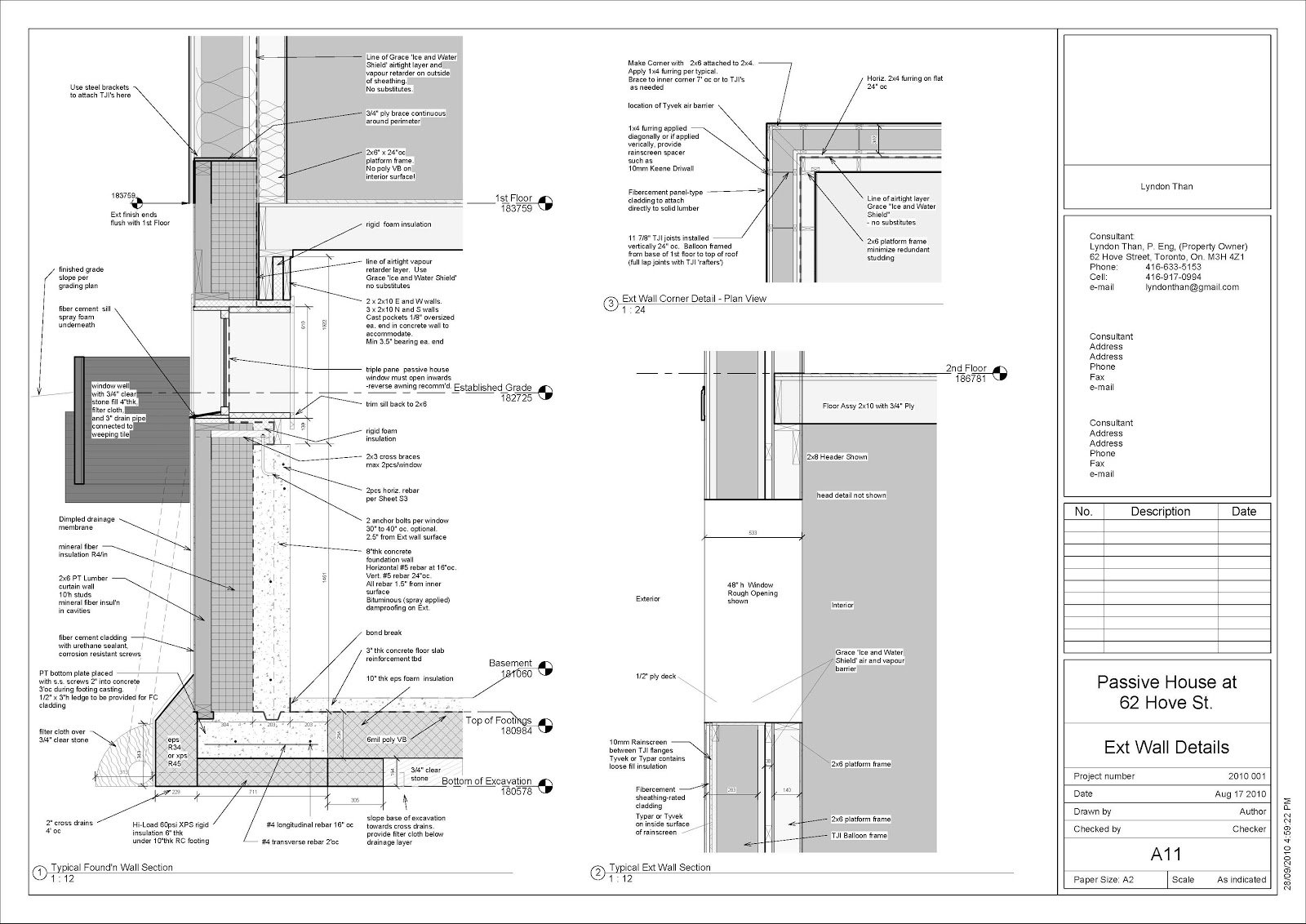
I thought I would post an earlier design I had prepared. We almost went for permit with this, but as we have a little more time now, I'm working to reduce the cost and foam contents of the foundation details, as you'll see in the earlier Dec 9 blog. There is also a little issue with the wall and roof structures - The amount of TJI's used. They are nice as one can get them easily in long continuous lengths, but the pricing has been an issue - I found them quite expensive compared to solid dimensional lumber. The other drawback is that they have very little tensile strength in the lateral direction - ie the flanges can pull off - they were never designed to take loading in that direction. My concern is that in the wall assy, they might not be great if the wall finish was heavy. In the roof, uplift forces may be a concern. Larsen trusses apparently can take a little more in this regard - but I think some testing should be done.

Thursday, December 9, 2010
Passive House Basement Foundation Detail
Here is a basement foundation section I came up with recently. I'm excited about this configuration for three reasons:
1. It uses very little rigid foam, which constitutes a cost saving, good environmental stewardship, and leads to good indoor air quality. the rigid foam may even be able to be eliminated altogether, depending on the thermal analysis.
2. The construction process will prove fairly straightforward and simple, with walls generally being able to be built in the flat and tilted up. The slab is the only concrete in the system, which also keeps the environmental footprint down. It is easy to build. The elevator pit can be incorporated into the wooden floor system, rather than needing to be formed into the concrete.
3. The exterior wall can be made with concrete, if a client is really too nervous about the wood, though the insulation value is reduced.
Other features, both good and bad, of this design include:

1. It uses very little rigid foam, which constitutes a cost saving, good environmental stewardship, and leads to good indoor air quality. the rigid foam may even be able to be eliminated altogether, depending on the thermal analysis.
2. The construction process will prove fairly straightforward and simple, with walls generally being able to be built in the flat and tilted up. The slab is the only concrete in the system, which also keeps the environmental footprint down. It is easy to build. The elevator pit can be incorporated into the wooden floor system, rather than needing to be formed into the concrete.
3. The exterior wall can be made with concrete, if a client is really too nervous about the wood, though the insulation value is reduced.
Other features, both good and bad, of this design include:
- Simplified plumbing, since most of it can be done above the slab.
- Possible issues with finished space - the building department may see the basement as finished space and charge more for the permit and subsequent property taxes.
- Pressure treated lumber - You'll see that the exterior shell suggests a very thin shield against the soil - I'm thinking 5/16" fiber cement siding, with asphaltic damproofing, then the HDPE dimpled membrane. This does away with the poured concrete wall - which takes a lot of space - say 8 or 10inches, which is a major financial and enviro cost, and gives nothing to insulation - and proposes instead a very thin shell, held up with lumber. The fiber cement shell is provided with the above moisture protection, but also with an additional drainage layer behind. This can prove an effective measure to ventilate the thick, insulated basement foundation wall, as well as to keep that outer shell very dry. The question, after all this, is - do we use PT lumber on the outer frame, or regular lumber? We all know the PT lumber is very hard on the environment - so my preference is to do away with it. Use regular lumber. The battens to which the FC siding is attached can be plastic-wood. - I'm still trying to figure that out - but the issue with all this is the buliding department - will they accept this untreated-lumber below grade construction? This will be a very interesting issue.
Here is the scan of my sketch:

Wednesday, December 8, 2010
Two Zoning Bylaws at Once - Illegal?
I was informed by Brian Parker (urban planner in Toronto) that section 34(30) of the planning act states the new bylaw mustn't be enforced by the OMB until all appeals have been dealt with.
Here are relevant excerpts from the planning act, R.S.O. 1990, Chapter P.13, Section 34:
-------------------------------------------------------------------------------------------------------------
Appeal to O.M.B.
To me this means the bylaw is deemed to have come into force on the day it was passed, but shall not be enforced until all appeals have been disposed. This is an interesting situation. Lets take some test scenarios:
Here are relevant excerpts from the planning act, R.S.O. 1990, Chapter P.13, Section 34:
-------------------------------------------------------------------------------------------------------------
Appeal to O.M.B.
(19) Not later than 20 days after the day that the giving of notice as required by subsection (18) is completed, any of the following may appeal to the Municipal Board by filing with the clerk of the municipality a notice of appeal setting out the objection to the by-law and the reasons in support of the objection, accompanied by the fee prescribed under the Ontario Municipal Board Act:
1. The applicant.
2. A person or public body who, before the by-law was passed, made oral submissions at a public meeting or written submissions to the council.
3. The Minister. 2006, c. 23, s. 15 (10).
When by-law deemed to have come into force
(21) When no notice of appeal is filed under subsection (19), the by-law shall be deemed to have come into force on the day it was passed except that where the by-law is passed under circumstances mentioned in subsection 24 (2) the by-law shall not be deemed to have come into force on the day it was passed until the amendment to the official plan comes into effect. R.S.O. 1990, c. P.13, s. 34 (21); 1994, c. 23, s. 21 (10); 1996, c. 4, s. 20 (8).
Hearing and notice thereof
(24) On an appeal to the Municipal Board, the Board shall hold a hearing of which notice shall be given to such persons or bodies and in such manner as the Board may determine. R.S.O. 1990, c. P.13, s. 34 (24).
Restriction re adding parties
(24.1) Despite subsection (24), in the case of an appeal under subsection (11) that relates to all or part of an application for an amendment to a by-law that is refused, or in the case of an appeal under subsection (19), only the following may be added as parties:
1. A person or public body who satisfies one of the conditions set out in subsection (24.2).
2. The Minister. 2006, c. 23, s. 15 (12).
Same
(24.2) The conditions mentioned in paragraph 1 of subsection (24.1) are:
1. Before the by-law was passed, the person or public body made oral submissions at a public meeting or written submissions to the council.
2. The Municipal Board is of the opinion that there are reasonable grounds to add the person or public body as a party. 2006, c. 23, s. 15 (12).
New information and material at hearing
(24.3) This subsection applies if information and material that is presented at the hearing of an appeal described in subsection (24.1) was not provided to the municipality before the council made the decision that is the subject of the appeal. 2006, c. 23, s. 15 (12).
Same
(24.4) When subsection (24.3) applies, the Municipal Board may, on its own initiative or on a motion by the municipality or any party, consider whether the information and material could have materially affected the council’s decision, and if the Board determines that it could have done so, it shall not be admitted into evidence until subsection (24.5) has been complied with and the prescribed time period has elapsed. 2006, c. 23, s. 15 (12).
Notice to council
(24.5) The Municipal Board shall notify the council that it is being given an opportunity to,
(a) reconsider its decision in light of the information and material; and
(b) make a written recommendation to the Board. 2006, c. 23, s. 15 (12).
Council’s recommendation
(24.6) The Municipal Board shall have regard to the council’s recommendation if it is received within the time period mentioned in subsection (24.4), and may but is not required to do so if it is received afterwards. 2006, c. 23, s. 15 (12).
Conflict with SPPA
(24.7) Subsections (24.1) to (24.6) apply despite the Statutory Powers Procedure Act. 2006, c. 23, s. 15 (12).
Coming into force
(30) If one or more appeals have been filed under subsection (19), the by-law does not come into force until all of such appeals have been withdrawn or finally disposed of, whereupon the by-law, except for those parts of it repealed or amended under subsection (26) or as are repealed or amended by the Lieutenant Governor in Council under subsection (29.1), shall be deemed to have come into force on the day it was passed. 1996, c. 4, s. 20 (13); 2004, c. 18, s. 6 (4).
-------------------------------------------------------------------------------------------------------------To me this means the bylaw is deemed to have come into force on the day it was passed, but shall not be enforced until all appeals have been disposed. This is an interesting situation. Lets take some test scenarios:
- The appeals are going forward. The bylaw is not enforced. The appeals, a year later, are all withdrawn or come to no result. The bylaw is then deemed to have come into force on the day it was passed, now a year ago. What happens to all those files that were processed without the bylaw enforced?
- The appeals are going forward. The bylaw is enforced, contrary to the planning act. All appeals come to no result. The bylaw is comes into force on the day it was passed, now a year ago. Everything is fine, except the law was broken for a year, with a bunch of people suffering the consequences. Now all those people can turn around and sue.
- The appeals are going forward. The bylaw is not enforced. They result in changes to the bylaw. A new bylaw is drafted and is subsequently passed, a year later. No legal battle arises for the files process through-out that year.
- The appeals are going forward. The bylaw is illegally enforced. The appeals process results in changes to the bylaw. A new bylaw is passed or amendments are passed. All those people who suffered the enforcement in the interrum can sue the city?
Perhaps a useful concept in resolving this could be to recognize the planning act is making a distinction between the date of enactment and the date of enforcement. It seems to imply enforcement does not automatically follow upon enactment of a zoning bylaw, but the date of enactment can be placed in the past, upon resolution of appeals.
......
Toronto Enforcing Two Zoning Bylaws Simultaneously
Oh the Pain! The Horror!
City of Toronto is enforcing both the old and new zoning bylaws simultaneously. I contacted Joe D'Abramo (Acting Director - Zoning?) last night and he returned my phone call this morning (bless him). He confirmed that yes, the two zoning bylaws are in effect simultaneously, and this will go on for some time, until all the appeals have finally been dealt with - so this means for a year or more - (I am thinking more - this is a costly and big process). There are 694 appeals. - Apparently 90% of them are lot/site specific.
Presently Joe's group are analyzing and sorting through the appeals. They hope to provide direction (early in the new year, he said) on which parts of the new bylaw are not under contest, so that the OMB can work to complete the instating of the bylaw on those parts only.
Below are a couple of links I came across on the zoning bylaw - neither discuss the enforcement of two bylaws, but the first gives a pretty good summary of contents and old-to-new differences, and the second discusses the appeals slightly.
http://www.gowlings.com/knowledgecentre/enewsletters/realestate/htmfiles/V1N02_20100920a.en.html
http://www.nationalpost.com/todays-paper/Harmonized+zoning+bylaw+spurs+appeals/3859605/story.html
Note --- see the later posts to get analysis and legality of this double-enforcement approach------
Joe explained that the new bylaw will be in effect retroactively to the August 25th, 2010 date, when the bylaw is finally cleared - but this bodes darkly for current projects - buildings will be designed based on both bylaws, and they will already be built or well underway by the time the new zoning bylaw is fully implemented - meanwhile the appeals process will change the bylaw - which means any buildings being permitted in the interrum will likely not conform regardless - or if they did, it would be because they paid $1700 for the committee of adjustment review and waited over 4 months for the result, and based on a law that is changing! This seems unfair to all those people who are in the building process right now.
On the whole, I just find it unreasonable to both building departments and related services and builders that the new bylaw cannot go through it's birthing woes BEFORE it becomes enforced - the need to enforce it retroactively seems innappropriate, to put it mildly.
City of Toronto is enforcing both the old and new zoning bylaws simultaneously. I contacted Joe D'Abramo (Acting Director - Zoning?) last night and he returned my phone call this morning (bless him). He confirmed that yes, the two zoning bylaws are in effect simultaneously, and this will go on for some time, until all the appeals have finally been dealt with - so this means for a year or more - (I am thinking more - this is a costly and big process). There are 694 appeals. - Apparently 90% of them are lot/site specific.
Presently Joe's group are analyzing and sorting through the appeals. They hope to provide direction (early in the new year, he said) on which parts of the new bylaw are not under contest, so that the OMB can work to complete the instating of the bylaw on those parts only.
Below are a couple of links I came across on the zoning bylaw - neither discuss the enforcement of two bylaws, but the first gives a pretty good summary of contents and old-to-new differences, and the second discusses the appeals slightly.
http://www.gowlings.com/knowledgecentre/enewsletters/realestate/htmfiles/V1N02_20100920a.en.html
http://www.nationalpost.com/todays-paper/Harmonized+zoning+bylaw+spurs+appeals/3859605/story.html
Note --- see the later posts to get analysis and legality of this double-enforcement approach------
Joe explained that the new bylaw will be in effect retroactively to the August 25th, 2010 date, when the bylaw is finally cleared - but this bodes darkly for current projects - buildings will be designed based on both bylaws, and they will already be built or well underway by the time the new zoning bylaw is fully implemented - meanwhile the appeals process will change the bylaw - which means any buildings being permitted in the interrum will likely not conform regardless - or if they did, it would be because they paid $1700 for the committee of adjustment review and waited over 4 months for the result, and based on a law that is changing! This seems unfair to all those people who are in the building process right now.
On the whole, I just find it unreasonable to both building departments and related services and builders that the new bylaw cannot go through it's birthing woes BEFORE it becomes enforced - the need to enforce it retroactively seems innappropriate, to put it mildly.
Thursday, October 14, 2010
Hot Dip Galvanizing - Costs, etc.
OK, this topic is not really on Passive House.
Hot Dip Galvanizing in Toronto:
Cost: Rough Ballpark is $.40/lb of finished galvanised item, $295 min charge
Spec: ASTM A123, min thickness 3.4mil or 610g/Sqm or 2oz/SF
Tubular sections will require holes about 30% of section width each end of frame/item.
Bath is at 840deg F, so no sealed sections will be allowed due to danger of exploding, though part can also float in the molten zinc bath.
Partial dipping is possible but there can be practical issues with the conveying machinery and part set-up - so it depends on what the part looks like - shape, etc.
I love finding out stuff like this.
LT
Hot Dip Galvanizing in Toronto:
Cost: Rough Ballpark is $.40/lb of finished galvanised item, $295 min charge
Spec: ASTM A123, min thickness 3.4mil or 610g/Sqm or 2oz/SF
Tubular sections will require holes about 30% of section width each end of frame/item.
Bath is at 840deg F, so no sealed sections will be allowed due to danger of exploding, though part can also float in the molten zinc bath.
Partial dipping is possible but there can be practical issues with the conveying machinery and part set-up - so it depends on what the part looks like - shape, etc.
I love finding out stuff like this.
LT
Subscribe to:
Posts (Atom)


