Sunday, April 8, 2012

Framing Photos

Tall Walls

2x12 Platform supported on the elevator shaft and one slanted upright from the concrete.
North Facade, Temporary Stair.

South Facade.


Fir beams were a last minute addition.  It caused some level of delay, especially when I realized I needed them slightly stronger.  I decided to place them doubled at 24" OC, and I had to order an additional 7 after the first ones arrived (Montreal supplier).  They are solid fir, dressed 4 sides, 2.5" x 9.25", $4.90/ft.  Our gluing job was not very successful and thus the C-clamps holding many of them.  More clamps are needed.  This is a great way to 'improve' headroom without having a change in floor heights upstairs, and without incurring additional exterior wall areas to be made (which is the usual result of taller ceilings in houses).  Our ceilings on the main floor are 9' to bottom of joists.  One-side-good special fir plywood was placed atop the beams.  The beams are placed carefully so as to be directly underneath the closet walls upstairs.  So no blocking is required under those walls, and nails will go directly into the joists.  We were careful to use galvanized nails on the joists to avoid rust stains.  When the last 7 beams arrived, this was forgotten and some rust stains have now appeared on the affected members - so far very minor.  We will see how much sound attenuation is needed over this area.  If a lot, we may need to add a sound absorbing medium to the floor upstairs.  This possibility was addressed by building all the door openings 3" taller upstairs, anticipating possibly a gypcrete pour on the floor, and sono-base panels under the finish flooring.

Cast in Place Electrical Outlets

Our search for cast-in-place electrical outlet boxes for the exteriors of the concrete basement walls ended without result.  We've probably all seen those grey PVC or painted aluminum outdoor boxes mounted on the surface of the basement walls.  Ugly.  Oddly enough, there is very little out there to address this issue.  I did find one product by IPX called Kwik-On.  Normally, electricians use 'slab boxes'.  These are similar to the metal boxes used for surface-mounted outlets.  They have no way to secure them to the concrete forms (odd, but true) - I believe the EMT conduit is intended to keep them in place while the concrete is poured.  They are not designed for exterior use, or for walls, and the electrician tapes them all ove to keep the concrete out.  There is also product in Europe where they tie the box to rebar and then cast around it.  The opening is knocked out later.  Availability and cost led us to design our own solution - which was relatively cheap - Materials for each box cost about $7.  Quite good, I would say.

It was just a simple outdoor PVC box mounted to an oiled wooden plate screwed to the box face.  PVC conduit was affixed to the back of the boxes so they could carry wire into into the building from the box.  The wooden plate was delicately mounted to the concrete forms with small nails.  Note:  make the total length a good 1/4" or more shorter than the thickness of your concrete walls - our forms were not well cleaned and the concrete scale on their inside surfaces sometimes interfered with the delicate boxes.  Also, be sure to carefully and thoroughly move the concrete around the boxes to ensure the concrete does not honeycomb around them.

Here are some photos of the process.


The conduit ends in a threaded coupler, sealed with tape for later removal.  Be sure to taper all sides of the wood plate well.  We tapered only the tops and bottoms and found removal after casting could have been a little better with all sides given a decent draft.
The depth and breadth of the depression left by the wood plate is large enough to accommodate the thick, hinged weather-proof PVC cover that will go on this.  Note, we may still apply another finish to the concrete - not likely stne veneer - possibly stucco, hopefully shot-blasting and staining the concrete.

Elevator in a Passive House

Here is our main floor layout:
Why would anyone install an elevator shaft in their house?  Can't people just climb the stairs? - its better for them.  We completely agree.  And if you'v ever used a residential elevator, you'll find it much slower than the stair.
However, there are some compelling reasons to consider the elevator shaft - note the key word - shaft.  We are not installing an elevator - but we are installing the shaft, which turns out to be quite cheap, even with us doing it the expensive way (more on that below).  Here is our thinking:
  1. We've seen seniors close to us living with their grown children.  It is really hard for them to go up and down the stairs.  We want a house which is inviting to our parents.  We've placed a bedroom and full bath on the main floor - but there are still stairs to climb to get to the first floor from the outside.  The elevator facilitates at-grade entry into the building.  It also allows the grandparents to easily visit their grandchildren asleep in their beds upstairs, or to join the family in the den for a movie, etc.
  2. Sometimes a family member is in a wheelchair.  The elevator embraces this.  Not to mention, any one of us can become a wheelchair user overnight. A house ready for an elevator is one less problem during a traumatic life-changing event.
  3. The elevator can make moving heavy or large objects much simpler - like pianos.
  4. Space lost to the elevator is not lost unless the elevator is installed.  The empty shaft (with floors installed on each level) can serve as pantry, powder room (with plumbing), closet, rock-climbing wall (no floors), etc.  We plan to use the shaft in these ways, until an elevator is actually installed.
Intended for economical installation, the shafts for residential elevators are intended to be built using regular framing lumber, with studs spaced extra-close and thicker plywood sheathing, or the use of 2x12's on the flat, flanked by studs within the wall framing.  Exact details are per the elevator manufacturer.  What is not explicitly laid out is that these walls are intended to be of standard height, framed between floors.  The idea is to place the elevator shaft in an area where there is a floor all around it, on all levels.  This did not happen in our design.  As our goal was to make the building accessible from the outside, we needed the shaft to be located near an exterior wall, and we ended up placing the shaft inside a wrap-around stair (the stair is placed on the north corner of the building - see plan).  Thus, a person entering the building from the north door arrives on the stair landing, from which he can enter the elevator.

The shaft walls needed to be about 28' tall.  This height is an added expense to frame, and if executed in wood, would take up a lot more space (tall wood walls tend to use deep studs too).  We therefore made a steel frame - cost of the steel - about $6000 incl delivery.  Concrete pad - $1000 labour and materials.  Crane - $600 minimum charge).
In addition the walls around the stair became very tall - from the footings to the ceiling of the 2nd floor.  28' long 1.75" x 9.5" LVL's (engineered lumber) were brought in to handle this, 12" OC, with double king studs.  The LVL's were about $4.90/ft - as costly as steel! 

Here is a video of the shaft going into the building on March 20, 2012.

...and some images;
The steel shaft arrives right on time from Ontario Steel with all the necessary certifications in a folder.  Our guys get on the truck and measure everything before we offload.  We are very pleased with their work.  Straight and square, and with good welds.  The piece is all 3.5"x3.5"x1/4" thick structural steel tube, and the finished weight is only about 2500 lb.

The crane operator removes the shaft from the truck.  We re-rig it on the driveway and then stand it up and into position.
The shaft in its home.

Look closely to see the 1/16" HDPE plastic gasket under the 1/2" steel plate foot.  Holes in the plates are 5/8".  Steel shims prepared ahead are ready for use.  Standard 1/2" x 8" HD galvanised  anchors are holding the frame to the 30MPa concrete pad with 10M reinforcement at 12"OC both directions.  The pad is about 10" thick - over strong, really.  The bottom of the shaft was prepainted with a finish coat of enamel.  The upper parts were only primed as we intend to weld to it.


You can see the 3" thick high-strength (60psi) rigid XPS foam insulation under the pad.  This material was about $70 for a 2'x8' sheet.

The bolt positioning jig is simply 3/4" plywood raised 1.5" from the concrete. You need to work the bolts well so there are no depressions in the finished concrete around the bolts.

Originally designed to be inside the elevator pit, the sump pit was installed to the side due to concerns about a clause in the elevator code requiring the the pit to stay dry.  We have both exterior and interior weeping tiles, and a very deep and large sump pit to accommodate 2 pumps.  

So how does Passive House deal with the elevator shaft? - I've had no official answer on this question, but assume it will be treated the same as a stair case - Total Floor Area of the elevator and shaft is not counted.  However, since we are installing only the shaft, we are expecting to have the area on three levels included in our PHPP.
I've also yet to ascertain the energy requirements of the elevator over the course of a year.  Again, we will be avoiding this issue (w.r.t. to PH certification) by not installing the elevator.

Saturday, March 10, 2012

All the Framing is Backwards!

We've had people go by our site and wonder why we were doing things backwards.  Normally, one builds the concrete walls and places a wood floor system on top of it.  We didn't.

The wooden house frame rests on the footings - not on the concrete walls.  Why?  One thing we're discovering about radically energy efficient buildings is the structure!

When the structure is not designed for insulation, it gets very hard to achieve thermal-bridge-free construction.  Placing the first wood (or steel, or whatever) floor frames on top of the concrete walls means there is a strong connection to the concrete (a heat conductor, not an insulator).  Unless the concrete is on the warm side of insulation, this is a significant thermal issue.  In our design, the structural concrete is all on the cold side of insulation.  (This means the outside shell of the building is hard.  When one thinks about a building lasting 25 years, having rigid foam on the outside might seem OK.  But what if we want  it to last 150 years or more?  Well, I don't know if that will happen with this house, but in case it does, it seems a good idea to have the outside shell be hard and durable.  One loses some potential to have thermal mass inside, but that can be achieved in other ways).  Getting back to the wood frame, we therefore have thermal separation between the inner frame of the house (which is the structural frame) all the way from the footings, up to the roof.  Therefore, framing starts in the basement, not on top of the concrete walls.  This might seem like a radical departure from conventional practice. But so far, in our project, we've found no real problem, and we are framing the 2nd floor walls now.


There are some considerations to handle, however.  First, we start with wooden walls, not floors.  The reason for this is that if we started with floors, the insulations inside them would get all wet.  So we wait for the roof to be on and the building closed up before building the basement floors.  This also reduces the natural settling of the building - pretty much all of the shrinkage of framing lumber happens in the floor frames.  Although we built the wide footings very level, we also shimmed the walls so they are not in contact with the concrete and any water can drain from under the walls, into the space between the footings, and finally to the sump pit.  

The walls against the concrete are not sheathed.  Again, this is so we can insulate the space behind the frames after the building is closed in.  We borrow shear strength from the concrete walls to stabilize these open frames.  The photo below shows a wide 3/4" plywood top plate (placed over the upper top plate) which reaches to the concrete and laterally anchors the walls to the concrete with steel brackets.  The 1/2" female Zamac anchors ($1 ea) were placed in the forms during the wall pour, but could probably be drilled in afterwards.  The concrete crew didn't really pay attention to the location of these anchors so you'll see that some of the steel brackets connect to the underside of the plywood, and some to the upper side.

Tuesday, January 31, 2012

Smallest Wood Stove and Smallest Wood Boiler

Adding some new information:
Yeaaaah!  We've found the whole load of stuff.  To find small boilers, look in the UK and Europe also, but lots of people use wood stoves in the UK, and they frequently have small houses, so there are lots of small wood stoves, and small wood stoves with what they call back boilers.
Charnwood has a distributor in NA, and their Cove 2B model could be a good size for low energy homes.
The following site lists quite a few different wood stoves with back boilers, some fairly small:

www.stovesonline.co.uk/stoves_with_backboilers.html
Also see:
www.boilerstoves.co.uk

And if you are looking for really quite a small output, the Salamander Hobbit below now has a back-boiler option (!).
Salamander is now also offering their Hobbit stove in a DEFRA -approved version and they have an even smaller stove called the Pipsqueak.


I have been getting more and more interested in the possibilities of wood stoves and wood boilers - BUT cannot find that very small, high-efficiency, sealed-combustion, direct-vent wood boiler!  This would be ideal for the occasional back-up hot water heating, and possibly snow-melting.  However, I have located a number of smallest wood stoves, some of which are beautiful!

Here are some:

http://www.salamanderstoves.com/docs/64/the_hobbit/  4kW output (14,000BTUh), $800 including delivery to NA.


The link below is really a very sweet little stove - The Thelin Gnome - it is a 16" diameter pellet stove.  Really Compact, but about $3000, I hear.
The search I do to find these things is now evolved to be 'Sailboat wood boiler', and 'micro wood boiler' and 'micro wood gasifier'. 

Here is a very cool stove for an RV or a Sailboat - made of stainless:  The Kimberly Stove:
It is about $3500, I think.

The Jotul 602 is about $1200 in the Toronto Area.
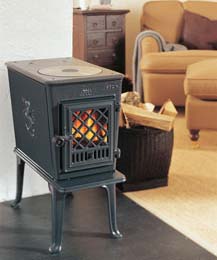
The F602 is listed at 28,000 BTU output - about 8kW - 19x11x25"h cast iron, non-catalytic clean burn 75% efficiency.  Uses room air for combustion.  Apparently there are really no direct vented wood stoves - I don't understand why.
I'm discovering there are a lot of these in the UK:
Here is the Acorn by Aarow, 4kw (about 14,000Btuh), and priced at 658 pounds.


8kW Wood Boiler available in the UK for 599 pounds.

Another one from the UK, this one priced at 539 pounds.


30,000 BTUh, 17x14x28"h including legs


http://www.marinestove.com/herringinfo.htm  This site lists three or four tiny wood stoves for sailboats.  Lovely.

http://www.waldeneffect.org/blog/Smallest_wood_stoves/

http://www.youtube.com/watch?v=xDUrSsILmNA&feature=related

http://www.fatscostoves.com/

http://www.theboilerwerks.com/

http://www.refleks-olieovne.dk/

http://www.blakes-lavac-taylors.co.uk/prod01.htm - Kerosene, Diesel, and Parafin heaters

A very small, 55,000 BTUh on-demand propane water heater:
http://www.globaltowne.com/product_info.php/products_id/54

An Excellent resource on heating with wood, its history and all the different types of wood burning appliances.
http://autonopedia.org/crafts_and_technology/Woodburners/Wood_Stoves_Part1.html

Ah!  Found a water heater for a jacuzzi - the CHOFU!
http://www.islandhottub.com/woodhtr.html - about $1200 from Amazon.com right now.

To convert any woodstove into a water heater:
http://www.hilkoil.com/  By the way, as far as I can tell, there are wood boiler makers using these coils such as this one:  http://nationalstoveworks.com/hotwaterstoves.html

An engineer who's built his own wood-fired cookstove/space heater/water heater.
http://www.gulland.ca/homenergy/stove.htm

Wednesday, January 25, 2012

Construction Has Begun

So much to report!

We started construction.  There's been about 2.5 months in prep, but just three weeks with crews on site -
Starting Tuesday Jan 10th:

Prep:
Moving out, finalizing drawings (ongoing!), disconnecting electricity, gas, water, phone, etc. Salvaging all we could form the old bungalow, sourcing specialty materials, building window and door bucks for the forming, and getting the detached garage ready to act as an onsite workshop and office.  The house was standing until Jan 10, 2012, when the following took place:
  1. Week 1:  demolition and excavation - Details:  removal of soil:  $600 per load (including excavation).  For haulage only, the soil removal is $275/load - one load is one full size dump truck), 35 truck-loads to remove - building foot print was increased only about 500 SF, but we also went about 12" deeper into the earth.  Garbage - everything other than masonry/concrete.  The excavator crushes the building into the basement until everything is in small pieces - then scoops it out into the garbage bins.  The 40-Yd bins are $125 delivery/p/u plus $75/ton dumping.  Concrete/masonry recycling is $275 flat fee for 14-yd bins.  Excavator on site for 3 days.
    This phase was pretty standard.  Expensive to remove soil!
    Terraprobe performed a soil verification just an hour after the final excavation with the entire pit open (3-page report - $450 plus tax).  They found our soil strong enough to hold 200kPa at SLS and 300 kPa at ULS.  It is Glacial Till.
    Straw was spread in the pit Thursday evening. - It is lovely and easy to work with at this point.
    Surveyors came on Friday to drive in these 3/8" pins marking the corners of the building.  They used standard practice, marking the exact corner of the building, without any offset.  Normally, the pins end up inside the footings, and the footing forms are placed outside these pin locations.  In our case, this caused a problem because our footings were to be exactly in line with the outside edge of the building - so the pins were in the way.  Note also the surveyors don;t really provide any height reference - they expect the footings to be placed on the bottom of the excavation, and levelled using bubble levels.  As we would be making very precise footings, we didn't like this idea.  We used a laser site-level instead.
  1. Week 2:  Footings - Form and Pour - Cold weather this week - we worked in minus 5C to minus 10C weather - one day it was minus 17 C wind-chill.  The 30 bales of straw kept the earth in the pit from freezing.  We added another 8 bales later.  Footing forms took extra time - we did it ourselves due to the careful design of the wall-to-footing intersection.  As the basement walls would be in-line with the edge of the footings, the forms had to be executed precisely along their outer edges.  The forms for the outside edges of the footing would stay in place after the footing pour.  They were anchored to the footing using the Zamac T-35 female anchors at 8' OC.   Wall forms could then rest on the footing form, which was 2x12 material, so only 1.5" wide.  These had to be precisely in the right place, and also very firm.  We felt this was necessary because we wanted to form a key at the outer edge in the footing to hold the walls against earth pressures, and also to improve water sealing (dowels would have been enough to hold the wall, I think).  There is no concrete floor slab to hold them, as in most regular basement foundation structures.
    The floor slab was to be placed between the footings rather than on top of them.  This, and the thick footings (11.25") will allow us to place insulation under the basement sub floor, while the basement floor joists rest upon the footings.  We seemed to have done a good job forming the footings, because there were absolutely no issues in placing the 10' wall forms later on.  This seems an ideal way also to form lot-line footings.  We used higher-strength (25MPa) concrete all around to improve water-tightness.  I also feel drainage of water down along the basement wall is improved by having the footing and wall edges in line.  The seem between wall and footing is easily bypassed and the water can flow right down to the weeping tile.   Weeping tile will be placed on both sides of the exterior footings, draining to a deep sump pit in the bottom of the elevator shaft.  Drainage of the basement is of utmost importance since the airtightness requirements will mean a permanent subfloor will be needed in the basement, as far as we can figure out for now.   - And we don't want any water under this floor.
Footing Forms made using 2x12's.  Ext footings are 26" wide to accommodate the double basement wall system.  Ext surface of basement walls will be inline with the outside edge of the footings.

Female concrete anchors to hold outer footing forms after the pour.  Note also the continuous 2x4 key at footing edge.  2x12 forms.


Exterior Edge of completed footing.  15M Rebar Dowels at 2' OC placed against the 'key'.  The 2x4's that formed the key have been removed.

Week 3:  Concrete Basement Walls - Form, Pour, Strip, Spray, and Apply Weeping tile, membrane, etc.  It took a crew of 8 the full day to place all the 10' forms, place the ties, the rebar and window bucks, and straighten and brace the forms, and place the scaffold.  Next morning they oil-sprayed, did some final straightening and bracing and poured all the concrete (4.5 trucks - 36 Cubic meters) in 3 hours.  We cast electrical outlets into the walls - I looked long for plastic boxes designed for casting in place.  I did find them (Kwik-on is one), but they needed ordering, and weren't cheap.  The normal stuff to use is what contractors call 'slab-boxes', which are just metal boxes without holes - all knock-outs instead.  Cheap, but not good, IMO.  I came up with my own instead.

Friday, December 23, 2011

A Rather Massive Roof

Well the hip was 'Piddley', and some said it was like a chunk cut out from the roof.  I personally liked it, and the reduction in mass it offered but we were also encouraged to make a simple, single gable.  Here is the result.  Still don't see any connection to the neighbours, as per the recent comment in the last post, but that is a tougher issue, perhaps, and will be worked on soon.

The taller, and more massive gable struck me as elegantly simple, though it gives the building a more serious air, compared to the cuter three-part roof.  One major excitement is the improved solar angle and the now much larger surface for solar PV modules, which are way down in price right now at about $1.73 per watt, with the required Canadian content.  I'd love to have the entire roof covered with panels, but the sizing is not working out qutie yet.  The west facade is rather plain and needs work too.

Monday, December 12, 2011

Last minute change?

We are about to demolish, excavate, and start concrete work.  Wife and Hubby disagree on the roof line!
A:  features the Hip Roof on the West side.  B: Features a gable instead.

A:


B:

What do you think?
Thanks
LT

Friday, October 14, 2011

Disconnection of Services

We've moved out of the house and have started deconstruction.

We are disconnecting services, including gas, electricity, water, etc.

Re. Electrical:
Toronto Hydro wants min. 2 to 3 weeks to perform the meter recovery, as they call it.
Our neighbours are OK with us using some of their electricity, so no temoporary service will be installed.
Re. New connection:  Underground service will require a $1000 fee for 'design' by Toronto Hydro, and up to $7000 to install.  Lead time is 14 to 16 weeks, so it could miss our foundation backfill, which means they'll dig a new trench.   Meter location is not too important now since they are using smart meters, but if the service is an overhead line, they will probably install the meter at the front of the house anyway (right near where the overhead line connects to the house).  Then we underground conduit to the back of the house, where our Utility Room is.  Conduit will be 18" below grade right beside the foundation....so this means a trench inspection, and we'll probably leave the backfilling operation short at the trench areas.
Trying to figure out where they want the damn meter.....
LT

Thursday, May 26, 2011

Toronto Zoning Bylaw Repealed

On May 18th, 2011 the city of Toronto repealed its zoning bylaw 1156-2010 (and all subsequent amendments to it), which was passed into law last Aug. 27th.  This means all the little parts of Toronto are back to their old zoning systems until the new bylaw is once again prepared to be enacted - apparently in Jan 2012.  In the meantime, the Planning and Growth Management Committee will continue to consult with residents.
There was a couple of amendments to the repeal motion - They provided that 500m setbacks from concrete production and distribution facilities and propane facilities be considered separately from the bylaw's repeal - in other words, these measures, brought into force with the initial passing of 1156-2010, may remain in force...it is still unclear to me for now.
I was impressed by Adam Vaughn in the Council meeting.  He was well informed, and calmly noted that the reason to repeal was not that it was a bad piece of legislation.  Implementation of the bylaw was the real cause of the problems.  The strange thing here is - the whole emphasis on the interim period is to meet with residents and concerned parties on the content - but the PGM Committee seem poised to follow the same implementation track when it is enacted a second time - that of enforcing two zoning bylaws simultaneously.  I don't see how implementation will be any easier at that time - except that there is now a period of about 8 months when everyone can rush their projects through.  Does the PGMC really expect that everyone will hold off on their projects for a year or so while the appeals (which will hopefully be fewer than 700) are dealt with?

I wonder what all those people who paid for zoning adjustments under the new bylaw have to say about the repeal?  I doubt there is any easy way for them to get a refund on the $1700 application fee.  The cost of the lost time, redesign work, and disruption to work crews would be significantly higher, I think.

I am amazed at the absence of this issue in the popular media.
LT